You did everything right.
You hired the top reps. You brought in experienced leadership. You invested in the best training: Force Management, Corporate Visions, Challenger. You bought the best tools: Gong, Clari, Salesforce. You have RevOps running the data and building dashboards.
And it is working. To a point.
Win rates are decent. Pipeline is moving. The board is not panicking. But forecast meetings still feel more like a negotiation than a prediction. Deals that should close on time slip. Your top 10% of sellers carry 60% of the number. When you lose a deal, the post-mortem says "price" or "timing" ... but you know that is never the whole answer.
There is a gap nobody measures.
Every B2B company tracks how much they sell: revenue, pipeline, quota attainment, win rate. These are lagging indicators. They tell you what happened. They do not tell you why.
Nobody baselines how well they sell. How effectively does your revenue organization convert product capability into customer-relevant business impact?
When a deal hits the CFO's desk, is there a defensible business case the champion owns, or is there a vendor-generated PDF that gets forwarded and forgotten?
The gap is not in the investments. It is in what is being measured. Imagine the revenue engine as an F1 racing team. The car has the best components, the best pit crew, the best team leader, and the best driver. But the alignment is off.
The training helps. The tools help. The experienced leadership helps. None of them close this gap by default. They create the conditions for value translation. They do not do the work.
Where we fit in.
I do not replace your training. I do not compete with your tools. I am not redesigning your sales process. I help everything you have already invested in work together with less friction.
Value translation is that connection. When it is present and repeatable, the same reps, the same tools, the same training, and the same leadership produce dramatically different results. Not because anything new was added, but because friction was removed.
What value translation looks like.
The same story told from different points of view.
The revenue leader builds strategy from annual plans. There is a clear playbook the enablement team coaches teams to execute. In reality, what you expect to happen and what really happens are almost never the same.
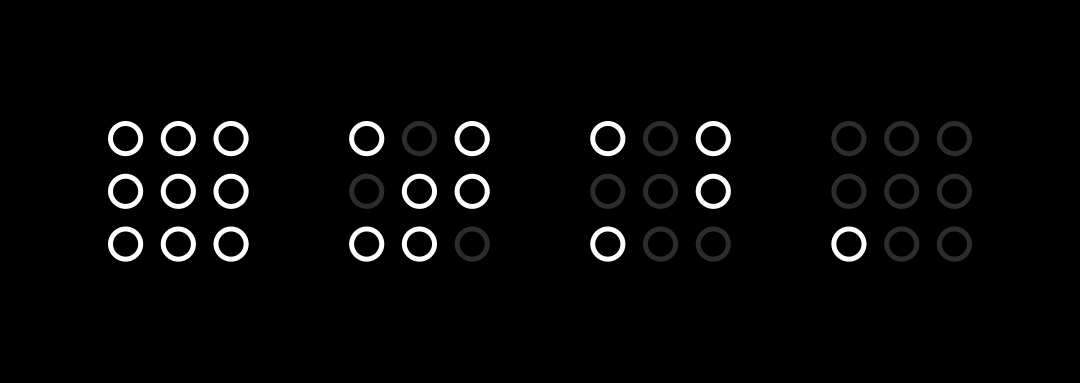
The sales manager running a deal review has the same problem from another angle. The deal is progressing. The champion wants the product. There is real pain. But how do you get the full picture before the forecast call?
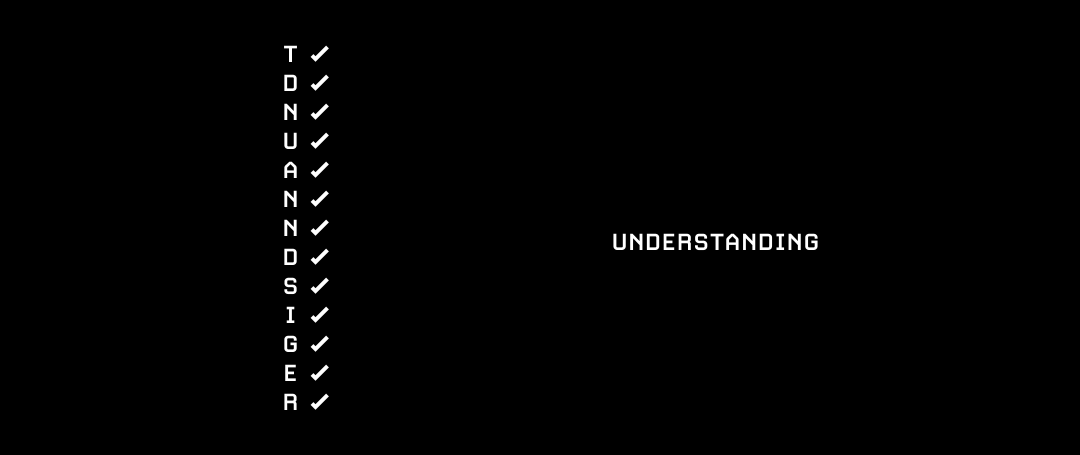
What value translation actually is.
Value translation is the organizational capability to take a product's technical functionality and translate it, consistently and repeatably, into business impact language the customer can understand, defend, and act on.
When value translation is present, the business case writes itself because the discovery was that complete. The champion can present to the CFO without the seller in the room because they helped build it. The pricing conversation starts with value, not cost.
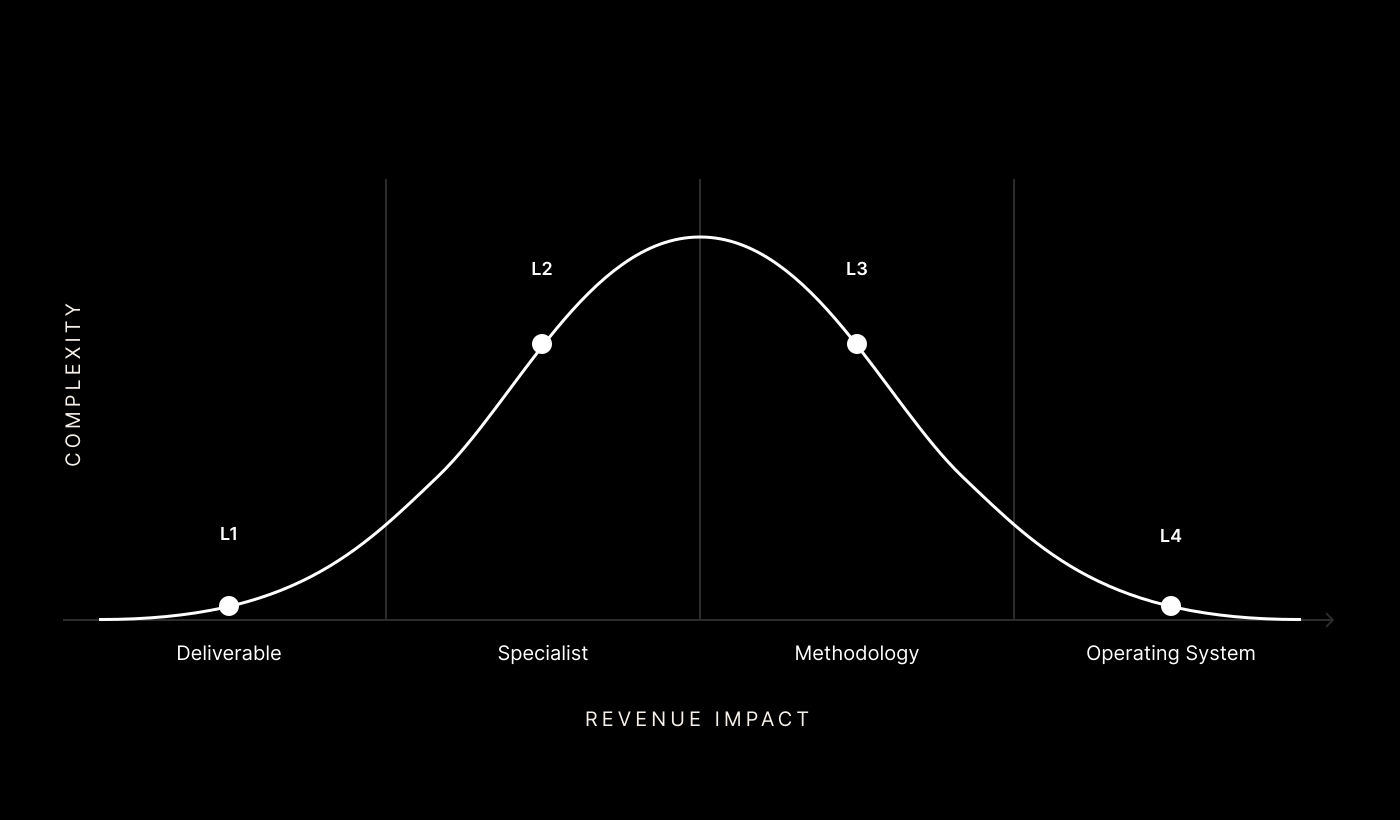
VT Maturity Curve
The gap is not what you are missing. It is the connection between what you already have. Value translation is that connection. When it becomes a repeatable capability, the same investments produce compounding returns.
A bell curve, not a ladder.
Informed simplicity exists on the far side of complexity. The learning loop looks like this:
- You start simple because you do not know better.
- You add complexity as you learn and experiment.
- You run at full complexity, demonstrating how much you have learned.
- You return to simplicity but better. You now know what matters, what does not, and more importantly, why.
Quick Guide
- Teams mature at different speeds. Your enterprise team might be at Level 2 while SMB is at Level 1. Maturity is not uniform and that is normal.
- Levels build on each other. You do not skip from Value as a Deliverable to Value as the Operating System.
- Context is the foundation. The ability to see the customer's world clearly enough to articulate why they need to change unlocks everything above Level 1.
- Not everyone needs to be a value expert. At Level 3 and beyond, a small percentage of the org builds and manages the value practice. The system enables the team.
The four levels.
| Level | How the team sells | What the buyer gets | Business impact | What changes with iS |
|---|---|---|---|---|
| L1: Value as a Deliverable | Feature-led pitches. Surface discovery. No value hypothesis. Discounting is the default closer. | A deck and a price quote. Nothing to defend internally. The deal dies in procurement. | Win rates below benchmarks. Pipeline looks full but moves slow. Losses attributed to "price." | Awareness that the gap exists between the product and the customer's language. |
| L2: Value as a Specialist | Hero dependency. Top reps sell on value naturally. Everyone else leans on heroes for heavy lifting. Nobody documents the difference. | Depends on which rep. Best reps: full price, clean deal. Everyone else: discount, stall, or lose. | 60%+ of quota from top 10% of AEs. Bimodal performance. Cannot replicate what works. | The hero's method gets extracted, documented, and built into a repeatable process. |
| L3: Value as a Methodology | Discovery frameworks. Value hypotheses before demos. Co-created business cases. Value-based deal inspections. | A defensible business case they own. Clear success criteria. A champion who can present without the seller. | 1.5-2x win rates. Deal sizes increase. Forecast accuracy improves. Discount rates decline. | The process becomes culture. Value translation embeds in coaching, incentives, and post-sale. |
| L4: Value as the Operating System | Pre-sale and post-sale connected. Value realization feeds expansion. The proof-to-price loop runs automatically. | Documented impact. Renewals that defend themselves. Expansion conversations the customer initiates. | Win rates up across the team. Minimal discounting. Faster ramp for new hires. Renewals compound. | The system learns. Every deal makes the next one better. Value translation is how the org thinks. |
Advancing maturity levels.
- Level 1 to Level 2 = Recognition. Seeing that value translation cannot live in a document. It needs a dedicated person who understands the buyer's world.
- Level 2 to Level 3 = Process. Extracting what the specialist does and building it into a repeatable methodology the whole team can run.
- Level 3 to Level 4 = Culture. Value translation stops being a methodology and becomes how the organization thinks, coaches, sells, and retains.
Inside the value framework.
Where it came from.
The original value framework began to take shape during my time launching the value practice at LogicMonitor in 2020-21. By focusing on creating the right conditions for buyers and sellers to more easily communicate about value, the teams I supported saw 150% higher win rates, 2.6x bigger deals, and 40% faster velocity.
What it is actually for: establishing a common language between seller and buyer. Sales has spent decades optimizing the seller's process. The value framework asks a different question: are we aligned with how the customer actually buys?
The framework is composed of three phases, eight capabilities, and twenty-five behaviors. Each one is something a customer needs to make a decision they can defend internally.
The three phases
Clarity
Can your sellers see the customer's world clearly enough to articulate why they need to change? Does the customer really understand how this is impacting their business?
Agreement
Can your organization build and defend a business case the customer owns, in the customer's language? Can your team sell with the customer, not to them?
Tracking
After the deal closes, can your organization prove the value was delivered and use that proof to expand?

The eight capabilities
Each capability is one of eight things a customer needs the organization to do well to make and defend a buying decision. Skip one and the deal slows, stalls, or closes on a discount.
| Phase | ID | Capability | Ask | Why this matters |
|---|---|---|---|---|
| Clarity | CL1 | Customer Context Fluency | Does the selling motion start in the customer's world? | Most orgs start with the product and work backward to the customer. The ones that start with the customer's world and work forward close more, faster, at higher prices. |
| Clarity | CL2 | Value Hypothesis Capability | Before committing resources, is there a testable business impact statement? | Most orgs skip this step. They go from discovery to demo with no explicit statement of expected business impact. |
| Clarity | CL3 | Stakeholder Alignment | Are the right people involved at the right stages? | Complex deals stall because the wrong people are involved, or the right people are not. This is about architecture for who needs to believe what, when, and why. |
| Agreement | AG1 | Business Case Co-Creation | Is the business case built with the customer or for them? | The business cases that work are co-created. The customer owns the assumptions, validates the math, and can defend the investment because they helped build it. |
| Agreement | AG2 | Proof of Value Discipline | When you evaluate, is success defined in business terms? | POVs are where deals go to die when nobody defines what success means before the evaluation starts. |
| Agreement | AG3 | Budget & Investment Alignment | Is pricing connected to value or presented as a cost? | The difference between "it costs $500K" and "the investment is $500K against $3.2M in impact" is the difference between price negotiation and a business decision. |
| Agreement | AG4 | Differentiation Through Value | How do you win: features or outcomes? | Feature wars are races to the bottom. Value differentiation is a race to clarity. |
| Tracking | TR1 | Value Realization & Expansion | After the deal closes, do you prove the value and use it to grow? | The org that can say "we promised X impact, we delivered Y, here is the proof" expands accounts instead of defending renewals. |
The twenty-five behaviors
Each capability breaks down into observable behaviors. In the VT Profile scoring rubric, each behavior is graded on the same four-level scale: 1 Absent, 2 Ad Hoc, 3 Defined, 4 Optimized.
The point is not any single score. The pattern tells the story.
Clarity
Is the deal real? Does the selling motion start in the customer's world?
| Capability | ID | Behavior | 1 Absent | 2 Ad Hoc | 3 Defined | 4 Optimized |
|---|---|---|---|---|---|---|
| Customer Context Fluency | CL1.1 | Know the business model | No research. Pitch without context. | Some reps research. Most lead with product. | Discovery maps the business model first. | Reps articulate the customer's business better than most insiders. |
| Customer Context Fluency | CL1.2 | Validate through discovery | Surface-level or skipped. | Happens but disconnected from hypothesis. | Questions designed to confirm or refine. | Structured validation. Hypotheses updated live. |
| Value Hypothesis Capability | CL2.1 | Connect to business outcomes | Feature-led. No translation. | Intuitive for top reps. No framework. | Value hypotheses connect to financial impact. | Every conversation starts with the outcome. |
| Value Hypothesis Capability | CL2.2 | Quantify the status quo | No attempt to put dollars on the problem. | Referenced but never calculated. | Customer data builds the cost-of-inaction case. | Quantified, agreed upon, and anchors every pricing conversation. |
| Value Hypothesis Capability | CL2.3 | Hypothesis before demo | Demos are generic. | Loose hypothesis. Standard deck. | Testable hypothesis required before any demo. | Hypotheses refined iteratively. Demos validate assumptions. |
| Value Hypothesis Capability | CL2.4 | Customize by persona | One pitch for all audiences. | Top reps adjust. No system. | Different value stories per buyer role. | Adapted in real time based on stakeholder signals. |
| Stakeholder Alignment | CL3.1 | Map stakeholder priorities | Single-threaded to one contact. | Top reps map key players. Most do not. | Stakeholder mapping is standard practice. | Influence patterns tracked and updated live. |
| Stakeholder Alignment | CL3.2 | Identify economic buyer | Unknown until late or never. | Sometimes identified, rarely engaged. | Engaged within the first two meetings. | No economic buyer means no progression. |
| Stakeholder Alignment | CL3.3 | Multi-thread the deal | Single-threaded. | Some build 2-3 contacts. | 3+ relationships per deal. Coached and inspected. | Influence maps maintained. Champion, blocker, coach identified. |
| Stakeholder Alignment | CL3.4 | Align on shared outcome | Each stakeholder hears a different pitch. | Champion aligned. Others unknown. | Facilitated sessions create shared success criteria. | Committee co-authors success criteria before the proposal. |
Agreement
Is the value work actually happening? Is the case real, proven, priced against outcomes, and differentiated?
| Capability | ID | Behavior | 1 Absent | 2 Ad Hoc | 3 Defined | 4 Optimized |
|---|---|---|---|---|---|---|
| Business Case Co-Creation | AG1.1 | Build the business case | No business case. Relationship or demo sells. | Vendor-generated ROI slides. | Co-built with champion using their data. | CFO-defensible. Customer owns the model. |
| Business Case Co-Creation | AG1.2 | Champion owns the case | No champion or nothing to present. | Supportive but cannot articulate independently. | Champion walks through it without the rep. | Champion actively sells internally. Their tool, not yours. |
| Business Case Co-Creation | AG1.3 | CFO-defensible rigor | "Trust us, it is worth it." | Basic ROI. Vendor assumptions. | Customer metrics. Documented assumptions. Conservative. | The CFO could present this to the board. |
| Proof of Value Discipline | AG2.1 | POCs with success criteria | Free trials. No criteria. | Loose goals. Feature tests. | Documented criteria tied to business outcomes. | POC design is strategic. Results feed the business case. |
| Proof of Value Discipline | AG2.2 | Proof validates the hypothesis | Disconnected from any claim. | Shows the product works. Not the value. | Designed to validate the specific value hypothesis. | Translated into financial impact. Added to the case. |
| Budget & Investment Alignment | AG3.1 | Price without discounting | Discount is the first response. | Top reps hold. Most discount. | Investment framed against value. Discounting needs justification. | Discounting is rare. The case is already made. |
| Budget & Investment Alignment | AG3.2 | Price against outcomes | Price stands alone. | Occasional ROI claims. | Their data anchors the conversation. | Investment always shown as percent of value created. |
| Budget & Investment Alignment | AG3.3 | Budget as priority not resource | "No budget" ends it. | Some push back. No system. | Budget objections reframed as priority conversations. | The business case justifies new budget allocation. |
| Differentiation Through Value | AG4.1 | Differentiate beyond features | Compete on features and price. | Top reps differentiate. Most do not. | Outcome-based positioning is standard. | The value translation is the differentiator. |
| Differentiation Through Value | AG4.2 | Compete on business impact | Win/loss attributed to features or price. | Some competitive positioning. Mostly reactive. | Proactive framing based on demonstrated impact. | Won on the strength of the business case. Proof is the moat. |
Tracking
Did the value land? Does post-sale feed pre-sale?
| Capability | ID | Behavior | 1 Absent | 2 Ad Hoc | 3 Defined | 4 Optimized |
|---|---|---|---|---|---|---|
| Value Realization & Expansion | TR1.1 | Document delivered value | No post-sale value tracking. | Occasional case studies. | Value realization reviews are standard. | Real-time dashboards. Customers see it before you tell them. |
| Value Realization & Expansion | TR1.2 | Proof drives renewals | Renewals are procurement events. | Some reps reference value. | Renewals open with a value realization review. | Renewals defend themselves. |
| Value Realization & Expansion | TR1.3 | Expansion from realized value | Expansion is another sales cycle. | Happens opportunistically. | Proposals lead with documented value. | Customer asks about expanding before the rep raises it. |
| Value Realization & Expansion | TR1.4 | Post-sale feeds pre-sale | Pre-sale and post-sale disconnected. | Win stories shared in Slack. | Realization data systematically feeds future hypotheses. | Proof-to-price loop closed. Data refines everything. |
| Value Realization & Expansion | TR1.5 | QBRs on value not usage | QBRs show roadmap requests. | Utilization metrics. Polite nods. | Lead with business outcomes achieved. | Strategic planning sessions. Customer brings their goals. |
Is your team ready for VLA?
There are five conditions that have to be true before value translation can really take hold. The Value-Led Approach is the design philosophy underneath the curve.
VLA Readiness is the qualifying instrument. The VT Profile is the scoring instrument. Weakness in any one of the five conditions below creates friction that eventually collapses the initiative.
VLA Readiness
Strategic Clarity
Does leadership know who they serve and why those buyers care? Without ICP clarity and a differentiated value proposition, reps default to features because that is what they can control. Look for: can every seller articulate the same answer to "Why us? Why now?"
Seller Readiness
Do the reps have the mindset and skill for this work? Value selling requires curiosity, business acumen, and comfort with ambiguity. Look for: does the team lean in or resist when asked to think like a consultant?
Buyer Process Alignment
Does the sales process match how customers actually buy? Most sales processes are designed for internal reporting and forecasting, not buyer enablement. Look for: are you tracking what the buyer needs to do, or just what your rep needs to do?
Value Continuity
Does value extend beyond the contract, or does sales throw it over the wall? If value is a sales tactic that ends at signature, customer success inherits expectations they did not set. Look for: is there a handoff that transfers value context, or just a CRM record?
Execution Infrastructure
Are the tools, content, and coaching in place to reinforce the right behaviors? This is where most companies start, and it is the last thing that should be built. Look for: does enablement adapt quickly or get stuck in bureaucracy?
The shortest version.
You did everything right. The talent, the training, the tools, the leadership. And it is working. Mostly, for some reps, on some deals, some of the time.
The gap is not what you are missing. It is the connection between what you already have. Value translation is that connection.